Haunted by Atrocity by Cloyd Benjamin G
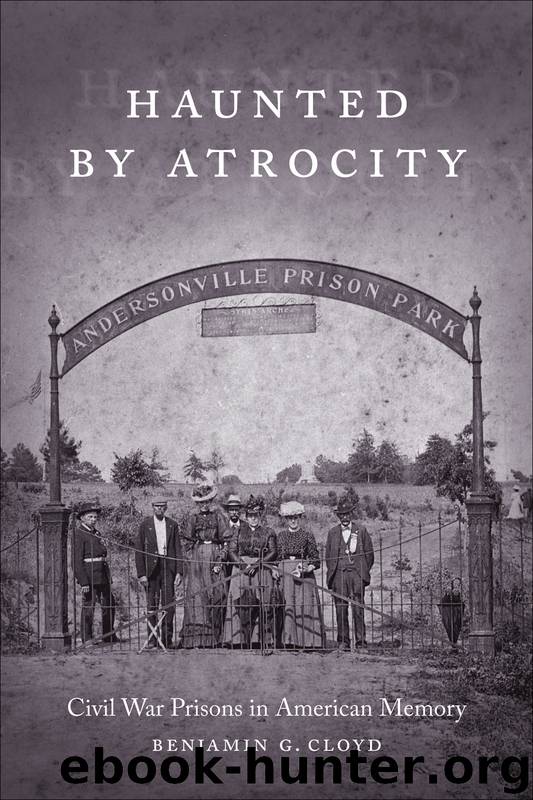
Author:Cloyd, Benjamin G.
Language: eng
Format: epub
Publisher: Lightning Source Inc.
Published: 2010-10-11T16:00:00+00:00
6
“Better to Take Advantage of Outsiders’ Curiosity”
THE CONSUMPTION OF OBJECTIVE MEMORY, 1960–PRESENT
From 1960 through the early twenty-first century, the view that both the Union and the Confederacy shared a generalized measure of responsibility for prisoners’ suffering and that both deserved criticism for their equalized failings became even more firmly entrenched. Instead of leading to the disappearance of the once heated prison controversy, however, the widespread acceptance of objective memory actually increased the attention that Americans paid to the subject of Civil War prisons. The diminished passions removed blame from the prison tragedy, and as the old stigma of deliberate atrocity faded, Andersonville in particular became the focal point of an accelerating trend during these decades—turning Civil War prison sites into tourist attractions. The success of the emerging tourist interest in southwest Georgia indicated that remembering Civil War prisons possessed commercial potential. And the enduring interest in the Civil War continued to thrive in American popular culture, as new prison histories, more prisoner accounts, and even movies about or featuring Civil War prison camps appeared. The proliferation of these products resulted from two paradoxical, yet inevitably intertwined, motives inherent to the American culture of capitalism. The commercialization of Civil War prisons transformed suffering, like any other raw material, into a profitable commodity stripped of its most controversial elements, but the avid consumption of objective memory also testified to an ongoing, unsatisfied curiosity in American society to understand more fully how such atrocities could ever have been possible.
The commercialization of Civil War prisons did not begin in the early 1960s, but the celebration of the Civil War Centennial represented a unique opportunity to turn memories of the conflict into profit. Initial enthusiasm for this commemoration ran high. Columnist Celestine Sibley feigned disbelief at the “great numbers of citizens who are as freshly, urgently, imperatively engrossed in some phase of That War as if it were day-after-tomorrow’s nuclear threat.”1 A. B. Moore, executive director of the Alabama Civil War Centennial Commission, explained that naturally Americans anticipated their chance to relive the war, which, after all, remained “the great national adventure.” Remembering “the sterling qualities” of the Civil War generation and cherishing “our great traditions” also provided an additional benefit, Moore believed—it protected the United States from “communist brain-washers.”2 Participation in the Civil War Centennial equated, at least for Moore, to a stand against the Communist Soviet Union. As a display of unity, the centennial offered North and South a chance to reconfirm the bonds of sectional reconciliation in the crucible of the Cold War.
That chance was not free from controversy, however. The necessity of avoiding the entanglement of objective Civil War memory with the rising tide of the Civil Rights Movement complicated the celebration for white southerners, at least some of whom, according to Atlanta Constitution journalist Harold Martin, “worried about the centennial” as a potentially “foolish thing.” Stirring “the old bones of a lost war” might reopen the “old wounds” of racial controversy by upsetting the dynamics of a Jim Crow South
Download
This site does not store any files on its server. We only index and link to content provided by other sites. Please contact the content providers to delete copyright contents if any and email us, we'll remove relevant links or contents immediately.
| Africa | Americas |
| Arctic & Antarctica | Asia |
| Australia & Oceania | Europe |
| Middle East | Russia |
| United States | World |
| Ancient Civilizations | Military |
| Historical Study & Educational Resources |
Cat's cradle by Kurt Vonnegut(15355)
Pimp by Iceberg Slim(14508)
4 3 2 1: A Novel by Paul Auster(12393)
Underground: A Human History of the Worlds Beneath Our Feet by Will Hunt(12099)
The Radium Girls by Kate Moore(12028)
Wiseguy by Nicholas Pileggi(5786)
The Fire Next Time by James Baldwin(5446)
Perfect Rhythm by Jae(5403)
American History Stories, Volume III (Yesterday's Classics) by Pratt Mara L(5308)
Paper Towns by Green John(5191)
Pale Blue Dot by Carl Sagan(5008)
A Higher Loyalty: Truth, Lies, and Leadership by James Comey(4964)
The Mayflower and the Pilgrims' New World by Nathaniel Philbrick(4504)
The Doomsday Machine by Daniel Ellsberg(4490)
Killers of the Flower Moon: The Osage Murders and the Birth of the FBI by David Grann(4447)
The Sympathizer by Viet Thanh Nguyen(4390)
Too Much and Not the Mood by Durga Chew-Bose(4348)
The Borden Murders by Sarah Miller(4325)
Sticky Fingers by Joe Hagan(4199)
